
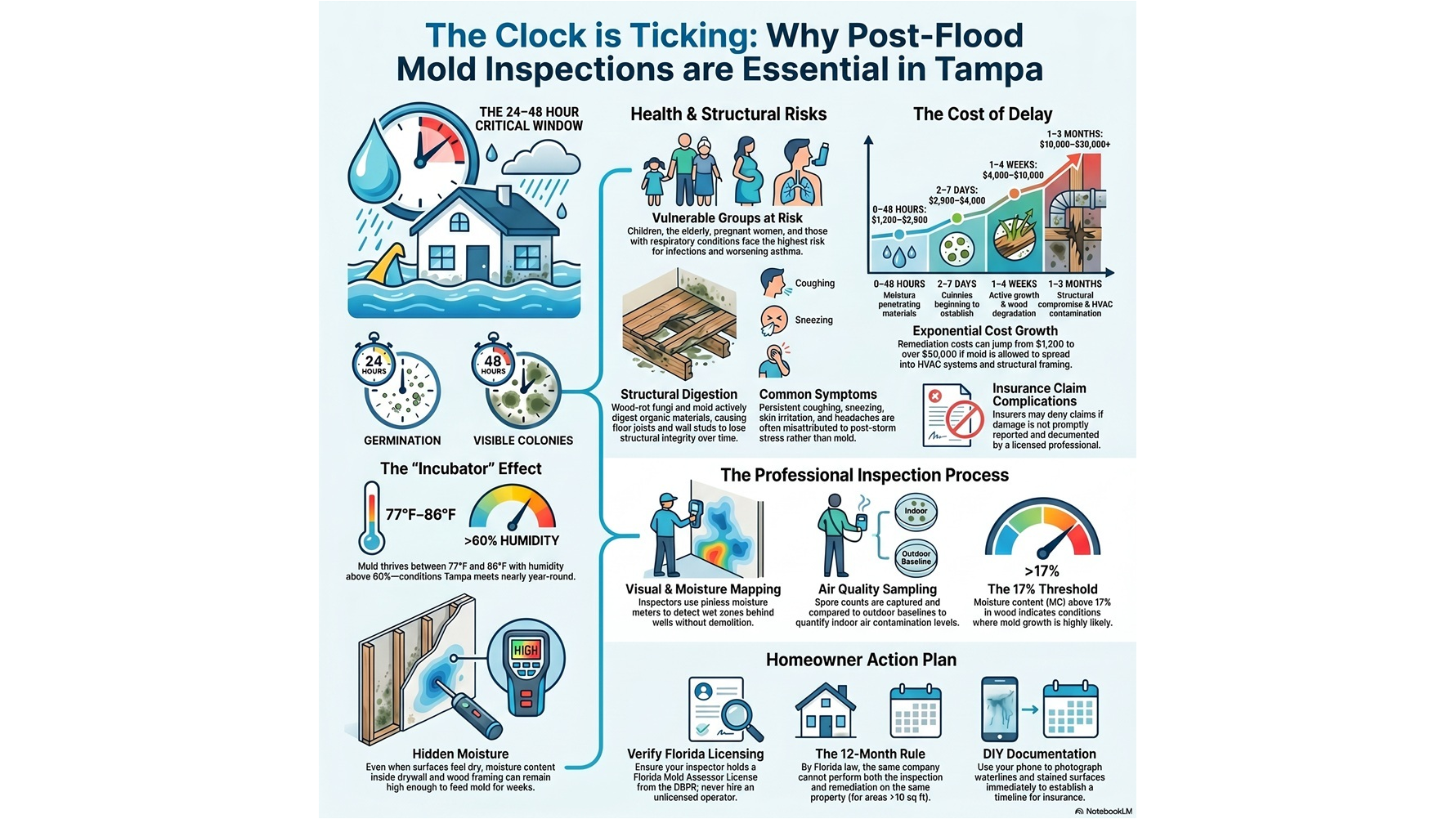
- Mold can begin growing within 24 to 48 hours after floodwater enters a home – Tampa’s heat and humidity compress that window even further.
- A professional mold inspection uses moisture meters, air sampling, and lab testing to find mold that is invisible to the naked eye.
- Skipping an inspection after a flood can lead to hidden structural damage, serious health effects, and a denied insurance claim.
- Florida law requires mold inspectors to hold a license from the Department of Business and Professional Regulation (DBPR) – and prohibits them from also performing the remediation on the same property.
- There is a critical cost threshold that determines whether mold remediation stays manageable or spirals into a five-figure project – keep reading to see exactly where that line falls.
After a flood, the water that is visible is not the biggest problem. The moisture hiding inside walls, beneath floors, and above ceilings is. Tampa homeowners face one of the highest post-flood mold risks in the country, and the subtropical climate is the reason why.
Tampa’s Climate Turns Floodwater Into a Mold Countdown
Tampa sits in a humid subtropical climate zone. Summer temperatures regularly fall between 80°F and 91°F, and relative humidity frequently exceeds 80% during and after storm events. Mold thrives between 77°F and 86°F when humidity stays above 60% – conditions that describe Tampa for most of the year.
Unlike homes in drier climates like Phoenix or Denver, where floodwater evaporates relatively quickly, Tampa’s ambient outdoor humidity continuously reintroduces moisture into building materials even after fans and dehumidifiers have been running. Standing water is only part of the problem. The air itself keeps feeding mold growth long after visible flooding is gone.
For homeowners dealing with water damage in the Tampa Bay area, TampaBayMold.net has published a detailed breakdown of why post-flood mold inspection is so time-sensitive in this region – including what inspectors look for that standard drying efforts miss entirely.
Mold Starts Growing Before Your Floors Feel Dry
Water does not simply sit on top of surfaces. It penetrates drywall, saturates insulation, soaks into subflooring, and wicks up wood framing through capillary action. Surfaces can feel completely dry to the touch while moisture content inside the material remains dangerously elevated for weeks.
The 24-48 Hour Prevention Window: Why Speed Matters Before Colonies Form
Under warm, humid conditions with an organic food source – drywall paper, wood studs, carpet backing – mold spores that are naturally present in any indoor environment can germinate and begin forming microscopic structures within 24 to 48 hours, with visible colonies typically appearing within 48 to 72 hours or a few days to a week. The U.S. Environmental Protection Agency advises that if a home flooded and could not be dried within that window, mold growth should simply be assumed.
By the time a musty smell is noticeable or dark spots appear on a wall, the colony has already been growing for several days and has pushed deeper into the material behind the surface staining.
Why Tampa Accelerates That Timeline
The conditions mold needs to thrive – warmth, moisture, and organic material – are present in Tampa homes almost year-round. Even with active drying efforts, outdoor humidity keeps reloading moisture into porous building materials unless the home is fully sealed with continuous dehumidification running. That is why mold inspections in Tampa carry more urgency than nearly anywhere else in the continental United States.
Health Risks That Are Easy to Misread
Mold is a structural problem and a health problem. Prolonged exposure to mold spores and mycotoxins – toxic compounds certain mold species produce – causes health effects that are often misattributed to seasonal allergies, a lingering cold, or post-storm stress.
Symptoms Most Households Will Notice
The most common symptoms of mold exposure include persistent coughing, nasal congestion, itchy or watery eyes, skin irritation, headaches, and fatigue. In homes with heavier contamination, shortness of breath and worsening asthma symptoms are also reported. What makes this especially difficult to catch after a flood is that these same symptoms are easy to dismiss as general stress responses from the disruption itself.
Who Faces the Most Serious Danger
Children, elderly adults, and anyone with a pre-existing respiratory condition like asthma or COPD are at significantly elevated risk. Immunocompromised individuals – whether from illness, medication, or ongoing treatment – face the most serious potential outcomes, including respiratory infections that can escalate quickly with sustained exposure.
Research following severe urban flooding has pointed to a clear association between post-flood mold growth and respiratory disease burden in affected communities, with mold exposure known to worsen asthma symptoms and contribute to broader respiratory illness.
What a Professional Mold Inspection Actually Does
A professional mold inspection goes well beyond a visual walkthrough. Certified inspectors use a combination of specialized equipment and laboratory analysis to build a complete, documented picture of mold risk throughout a property.
Moisture Mapping Behind Walls and Floors
Inspectors use both pin-type and pinless moisture meters to measure moisture content inside drywall, wood framing, and subflooring without requiring any demolition. Elevated moisture content in materials like wood and concrete indicates conditions where mold is either already present or highly likely. These readings are mapped across the entire home to identify hidden wet zones that look completely dry on the surface – the exact areas that cause the most long-term damage when missed.
Air Sampling and Lab Testing
Air sampling draws a measured volume of indoor air through a collection cassette that captures airborne mold spores. Samples are sent to an accredited third-party laboratory – typically with results returned within 24 to 72 hours, or 3 to 5 business days – where technicians identify species present and quantify spore counts per cubic meter of air. Results are compared against an outdoor baseline taken at the same time, so there is a clear, defensible record of how much indoor air quality has deviated from normal. This lab data is what insurance companies and remediation contractors use to define the scope of the problem.
The Real Cost of Skipping the Inspection
Choosing not to get a mold inspection after a Tampa flood is one of the most financially consequential decisions a homeowner can make. The problems do not stay contained – they grow, spread, and compound until a manageable remediation job becomes a whole-home restoration project.
Hidden Mold Spreads While You Wait
Mold growing inside a wall cavity has everything it needs: darkness, moisture, organic material in the drywall paper and wood studs, and limited airflow. Without detection, that colony can grow for months unnoticed, releasing millions of spores per day into living spaces through electrical outlets, light switches, and gaps at baseboards. By the time it becomes obvious – through persistent odor, worsening allergy symptoms, or staining bleeding through paint – the growth has typically spread to multiple wall cavities and potentially into HVAC ductwork.
The remediation cost difference is stark. Early detection within the first 48 hours typically falls in the $1,200-$2,500 range. Waiting one to four weeks, when active growth and early wood degradation have set in, significantly increases remediation costs. Full structural compromise with HVAC contamination – the outcome of months of undetected growth – can reach tens of thousands of dollars or more.
How Delays Can Negatively Impact Your Insurance Claim
Standard Florida homeowners insurance policies cover mold damage only when it results directly from a covered peril – such as storm-driven water intrusion – and only when the homeowner took reasonable steps to mitigate promptly. Many policies include specific language excluding mold damage that was not promptly reported or remediated, creating a clear basis for claim denial when action is delayed.
A professional mold inspection creates a timestamped, laboratory-backed document proving mold was detected within a reasonable period following the flood event. Without it, insurers can argue the damage resulted from long-term neglect rather than the specific event being claimed. Most Florida policies also carry mold sub-limits that can significantly cap coverage – documentation becomes especially critical when remediation costs risk exceeding those caps and a supplemental claim needs to be supported.
How to Choose the Right Tampa Mold Inspector
The inspector hired after a flood will produce a legal document that affects an insurance claim, the remediation scope, and potentially a home’s resale value. Credentials matter here in a concrete, verifiable way.
Florida Mold Assessor License Requirements
Florida is one of the few states that licenses mold assessors and mold remediators separately under Chapter 468, Part XVI of the Florida Statutes, regulated by the Department of Business and Professional Regulation (DBPR). Any inspector hired must hold a valid Florida Mold Assessor License – verifiable directly on the DBPR website before allowing entry to the property. Beyond that, confirm the inspector uses a laboratory accredited by the American Industrial Hygiene Association (AIHA), whose strict chain-of-custody protocols make results defensible in insurance disputes.
Why Your Inspector Cannot Be Your Remediator
Under Florida Statute 468.8419, a licensed mold assessor is prohibited from performing remediation on the same property within 12 months of completing the assessment – with a limited exception for visible mold under 10 square feet. This separation exists to prevent conflicts of interest, ensuring the inspection produces an objective scope of work rather than one inflated to generate remediation revenue. The inspection report defines the problem; licensed remediators then bid competitively on the same defined scope.
Schedule the Inspection to Prevent Damage from Potentially Exceeding Your Coverage Limits or Affecting Your Claim
Tampa’s climate, the biology of mold growth, and the structure of Florida insurance policies all converge on the same conclusion: a mold inspection within 24 to 72 hours of floodwater receding is not cautious – it is a necessary step. Every additional day without one is a day that hidden moisture is doing undocumented damage, colonies are pushing deeper into building materials, and the window for clean insurance reimbursement is narrowing.
The homeowners who recover best after a flood – financially, structurally, and health-wise – are the ones who treat the mold inspection as the first non-negotiable step, not an afterthought once the floors feel dry.
TampaBayMold.net provides licensed mold assessments backed by accredited laboratory testing for Tampa Bay homeowners navigating post-flood recovery.
TampaBayMold.net
550 N. Reo St. Suite #300
Tampa
FL
33609
United States


