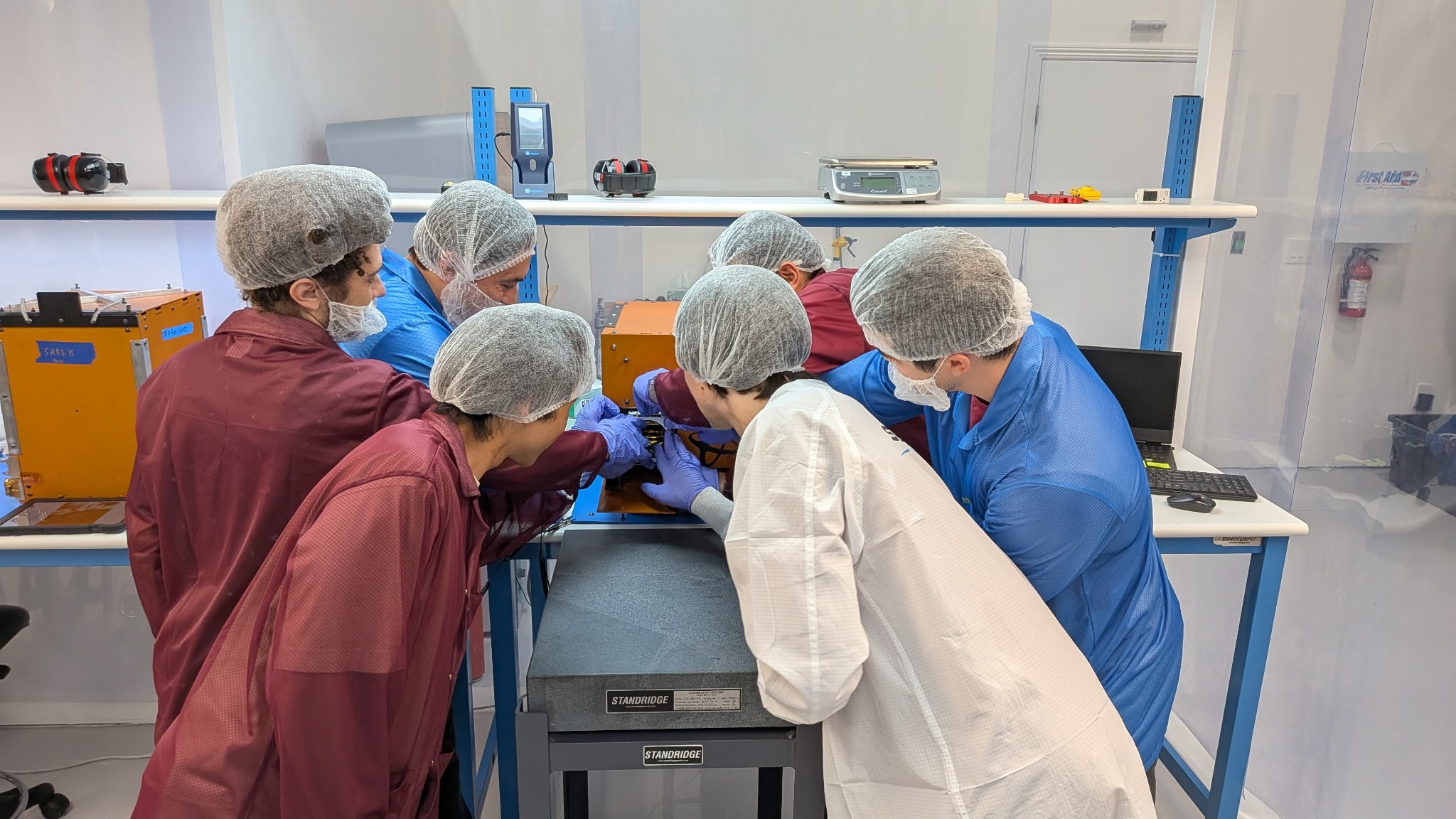
PSAI’s Data Fusion Software to Conduct First In-Orbit Tests for Training and Operations
NEW YORK , NY, UNITED STATES, June 25, 2026 /EINPresswire.com/ — Planetary Systems AI (PSAI), a leading provider of AI-powered decision support systems for space operations, today announced its first Concept of Operations (CONOPs) mission aboard the University of Southern California Space Engineering Research Center’s MAVERIC 3U CubeSat, launching in July 2026 on SpaceX Transporter 17 Sun-Synchronous Orbit Rideshare (SSO). SpaceX’s SmallSat Rideshare Program provides small satellite operators with regularly scheduled, dedicated Falcon 9 rideshare missions to SSO for ESPA class payloads for as low as $350,000 per mission, which includes up to 50kg of payload mass.
PSAI’s software demonstration will fly as a payload aboard MAVERIC, marking the company’s first operational deployment of its AI systems in low-Earth orbit. The mission will serve a dual purpose: collecting sensor data from two cameras – two dimensional and three dimensional non-earth images to train PSAI’s machine learning models, and conducting CONOPs for real-time processing in orbit, reducing need to downlink data sets, or cleaning or increasing resolution of images.
“This mission represents a defining moment for PSAI and orbital traffic management,” said Cindy Chin, CEO and Founder of Planetary Systems AI. “Taking our AI systems into orbit aboard MAVERIC and partnering with USC’s Viterbi School Engineering and Information Science’s Institute’s and Department of Astronautical Engineering Space Engineering Research Center (ISI SERC) was two years in the making. The launch gives us the ability to perform initial tests in an operational data environment we need to train our AI models under real conditions designed for launch directly. The work we’re doing in LEO today is foundational for space domain awareness and top national security priorities for the next two years.”
“Universities play a unique role in the space ecosystem by helping emerging technologies move from theoretical research into applied flight demonstrations,” said David Barnhart, SERC Director and Research Professor in USC’s Department of Astronautical Engineering. “Through the academically focused MAVERIC satellite, USC is giving students hands-on experience translating classroom lessons into real mission operations, while also providing a pathway for partners to evaluate innovative capabilities in orbit. MAVERIC’s support of PSAI’s first on-orbit demonstration reflects how university spacecraft can bridge education, research, and operational application.”
—
About Planetary Systems AI
Planetary Systems AI (PSAI) is a dual-use defense technology company pioneering AI-powered decision support systems for satellite operations and space domain awareness. The company’s autonomous systems operate at the intersection of advanced artificial intelligence and real-world space operations, delivering mission-critical capabilities for defense, intelligence, and commercial applications. PSAI holds active U.S. Department of Defense contracts including SpaceWERX SBIR Phase 2 awards and is advised by the U.S. Department of State on international Space Situational Awareness policy. For more information, visit www.planetarysystems.ai.
About USC MAVERIC
MAVERIC (Magnetic Vector and Remote Imaging Communication) is a 3U CubeSat developed by the USC Viterbi Space Engineering Research Center (SERC), a collaboration between more than 60 students, faculty, and industry advisors over two years. The satellite integrates four distinct payloads designed to advance satellite innovation and expand capabilities in space operations. The program, supported by Positron Capital Management, represents one of the most ambitious academic-industry satellite initiatives to emerge from USC’s astronautical engineering program.
The entire USC MAVERIC team was initiated by Positron Capital Management whose gift enabled this multi-year class led satellite to finally achieve orbit.
About USC Viterbi’s Space Engineering Research Center
The University of Southern California (USC) Space Engineering Research Center (SERC) is dedicated to disruptive space engineering, research, and education, including hands-on build, test, and flight demonstrations of spacecraft and satellites. Located at USC’s main campus and the Information Sciences Institute (ISI), SERC challenges traditional methods of space R&D and manufacturing with approaches that reduce costs and enable novel capabilities in space-to-space services and interactions.
Media Contact:
PSAI Communications
pr@planetarysystems.ai
www.planetarysystems.ai
PSAI Communications
Planetary Systems AI
+1 347-989-2522
email us here
Visit us on social media:
LinkedIn
Instagram
Legal Disclaimer:
EIN Presswire provides this news content “as is” without warranty of any kind. We do not accept any responsibility or liability
for the accuracy, content, images, videos, licenses, completeness, legality, or reliability of the information contained in this
article. If you have any complaints or copyright issues related to this article, kindly contact the author above.

Media gallery